Friday, March 23, 2007

Jere Thompson Jr.: We would forfeit billions with private partnership on 121

This is an informative read printed in today's Dallas Morning News

Over the past few weeks a drama has played out in Austin over the future of State Highway 121, a huge roadway that will soon be the equivalent of a 26-mile-long "LBJ Freeway" between Central Expressway and Interstate 35.

The story began over a year ago when the decision was made to obtain badly needed transportation funds by converting Highway 121 to a toll road and then selling a 50-year concession on it.

At the insistence of the Texas Department of Transportation, the North Texas Turnpike Authority – the region's only experienced toll road agency – was ultimately excluded as a bidder.

Last month, Gov. Rick Perry announced with some fanfare that a Spanish company, Cintra, had the winning bid of $2.8 billion for the rights to the toll road. That's when things got interesting.

At the request of state Sen. John Carona, the NTTA responded that it could likely "offer" $6.3 billion using the same general assumptions employed by Cintra.

How can the NTTA produce so much more than Cintra? Because of its lower cost of funds.

The NTTA requires no equity returns and has access to low-interest municipal bonds. This capital structure is significantly less expensive than Cintra's combination of taxable bonds and equity.

Therefore, with the same revenue assumptions, the NTTA can return $3.5 billion more to the region than Cintra. This amount is more than TxDOT spent on new road construction in Dallas, Collin and Denton counties during the past five years.

The contract with Cintra has not yet been signed. By selecting the NTTA, an additional $3.5 billion would become available to the region. By selecting Cintra, that same $3.5 billion would become profits for Cintra and interest income for Cintra's banks.

Which would you pick?

Welcome to the new world of comprehensive development agreements, commonly referred to as CDAs. They involve the sale of a toll road's revenue stream to a private entity in return for huge upfront signing fees and future revenue sharing.

CDAs can sometimes be good. Examples are ventures that the public sector is unwilling or unable to construct, very expensive urban projects with uncertain traffic estimates, and projects in rural areas with no history of toll roads.

The private sector's willingness to accept the construction, financing, traffic and revenue risks in these examples justifies their economic rewards.

On the other hand, a perfect example of a bad CDA is Highway 121. The NTTA is willing and able to finance and construct the project, right-of-way costs are known, construction cost increases are not being assumed by Cintra, noncompete penalties are provided, traffic can be reasonably forecasted, and area commuters have already demonstrated their receptiveness to toll roads. Cintra would capture very high rewards for very little risk.

Because of the controversy over Highway 121 and other projects around the state, a two-year moratorium on CDAs has been proposed in Austin.

Local opponents to the moratorium claim that critical projects will not get built and congestion will strangle our region.

But the proposed moratorium applies only to selling to the private sector the rights to public assets. The NTTA is a public agency and would be exempted from this moratorium. It could build and, with legislative permission, allocate funds to nontoll projects.

If the moratorium halts a flawed selection process, results in more transportation dollars for this region, and permits construction of critical projects without delay, how can it be viewed as anything but good?

How should the Legislature address the use of CDAs and solve the funding crisis?

First, regional toll road authorities should obtain the first right to build new toll projects and should not have to pay TxDOT for this right to build.

Second, toll road authorities should obtain the ability to allocate funds to nontoll transportation projects.

Third, funding raised from tolls should not reduce funding from gas taxes, and all gas tax dollars due this region should be promptly returned here and not spent elsewhere.

Finally, the only serious long-term solution to this crisis is to index gas taxes. When the pain of the status quo exceeds the pain of change, change happens.

The Legislature needs to increase and index the gas tax to fund new transportation construction.

Jere Thompson Jr. is a former chairman of the North Texas Turnpike Authority and its predecessor, the Texas Turnpike Authority. He now serves as the Transportation Chairman for the Dallas Citizens Council and the Trinity Commons Foundation. His e-mail address is jwt@ambitenergy.com.

Thursday, March 22, 2007

Corona: Friend or Foe?


From the Statesman


Carona was quoted in this paper and the Dallas Morning News today indicating that, well, he didn’t plan to let SB 1267 come up for a vote in his committee. Tarrant County officials, at yet another Carona hearing Wednesday, had made it clear they don’t want a moratorium because it could delay for years some road projects they were counting on to get going.

People like David Stall, with anti-Trans-Texas Corridor group Corridor Watch, and Austin toll opponent Sal Costello went into action. Carona’s office was flooded with demands that he give the bill a vote, and some of his staffers said, well, he’d been misquoted.

No, Carona’s office, later said, the news stories got it right. But he issued a statement at mid-afternoon trying to put his position on SB 1267 in context.

“There are things we need to accomplish this session, such as stopping or reducing diversion of transportation revenues, and indexing the motor fuels taxes,” the Carona statement said. “If all we do is pass SB 1267, then we have told TxDOT it is okay to build all future roads as toll roads, just not (private) toll roads… . We have heard the public loud and clear about toll roads, public private partnerships, and the Trans Texas Corridor. We have also heard from Tarrant County and others for whom SB 1267 creates a hardship, and we have an obligation to listen to them as well.”

Monday, March 19, 2007

Carona keeps eye on state roads

Since taking over as leader of the Senate Transportation and Homeland Security Committee – thanks to an appointment by Lt. Gov. David Dewhurst – the Republican lawmaker has made himself a force to be reckoned with in policy and planning for the state's multibillion-dollar highway needs.


Krusee is having to play defense

Nice little read........

March madness over tolls grips Legislature

Vexed by private tollway deals, affronted by TxDOT's attitudes, Legislature looks to rein in Perry's turnpike push


AMERICAN-STATESMAN STAFF
Monday, March 19, 2007

Mike Krusee looked tired.

The Republican state representative from Williamson County, interviewed at his Capitol office last week, for 10 days or so had been fighting what some people call the creeping crud, a debilitating mixture of cold, flu and allergy symptoms hitting many Central Texans this spring.

But Krusee, for much longer than 10 days, has also been fighting the creeping realization among legislators that over the past two sessions, they might have granted Gov. Rick Perry and the Texas Department of Transportation too much power to create toll roads. For the first time in his three sessions as chairman of the House Transportation Committee and the leading legislative architect of toll road policy, Krusee is having to play defense.

For a number of reasons — campaign trail grumbling last year, disputes with Dallas and Houston toll road agencies, lack of deference to legislators by Texas transportation commissioners, turf battles over huge pots of money suddenly coming Texas' way — the Legislature has been gripped by a sort of March madness over tollways, particularly those that would be in private hands for a half-century.

What remains to be seen is what the madness will lead to by the end of the session May 28. As transportation chairman, Krusee can, in theory, block most legislation seeking to roll back tollway powers. And Perry could veto whatever makes it to his desk.

But more than two-thirds of the Legislature has signed on to legislation that would put a two-year moratorium on concessions, contracts with private companies to build and run toll roads. Dozens of other bills limiting tollway powers have been filed. And powerful legislators, including Senate Finance Committee Chairman Steve Ogden, R-Bryan, are talking about using the power of the purse to curb the Transportation Department.

Perry and Krusee may have no choice but to make concessions on concessions and on other prongs of their toll road agenda.

"Watch the budget," Ogden said. "At the end of the day, TxDOT can't spend a dime without our permission. So, watch the budget."

Ogden has a unique role in the situation.

In 2003, when he was chairman of the Senate Transportation and Homeland Security Committee, Ogden sponsored House Bill 3588, a humongous bill that, among other things, authorized Perry's Trans-Texas Corridor plan and allowed the state to enter into concession agreements with private companies. That bill, conceived and carried by Krusee in the House, basically made possible everything that Ogden and most of the Legislature are now stewing over.

Ogden has filed bills that would prohibit the granting of long-term road leases and require that toll roads become free roads when money borrowed by government for construction is paid off. He says tolls should be a mechanism to get a specific road built, not a profit center. Those two short and simple measures would gut the Transportation Department's toll road policy.

Ogden was asked for his take on why he and so many other lawmakers have had second thoughts about their 2003 handiwork.

"What's going on? We had an election, that's what," Ogden said. "All we're doing is reflecting what we heard on the campaign trail."

Others paint a more complicated picture. Repercussions from HB 3588 were already being felt when the Legislature met in 2005. There was grass-roots toll opposition in Austin and San Antonio and widespread unhappiness among farmers and ranchers about the corridor plan to build 4,000 miles of tollways, railroads and utility easements. But although the Legislature made some tweaks in 2005, mostly to appease the rural concerns, nothing like this session's Category 5 blowback occurred.

It's one thing to upset residents of Austin or Fayetteville and quite another to get crosswise with toll road agencies in Dallas and Houston.

The Transportation Department, in its zeal to award long-term toll road leases to private companies and thus reap multibillion-dollar upfront payments from them, has managed to alienate the North Texas Tollway Authority and the Harris County Toll Road Authority.

The local authorities want first shot at operating toll roads in their areas and feel that the state agency has shouldered them out of the way.

On Feb. 27, the Transportation Department awarded a contract for Texas 121, a road in suburban Collin County north of Dallas, to a partnership headed by Cintra, a Spanish toll road company that earlier won a bid to build 41 miles of the Texas 130 tollway southeast of Austin with Texas partner Zachry Construction. Cintra said it could give the state $2.1 billion upfront and $750 million more over 50 years for Texas 121.

The North Texas Tollway Authority declined to bid on that contract, a choice that, depending on who is telling the tale, may or may not have been made under pressure from Texas Transportation Commission Chairman Ric Williamson and his department.

In Houston, the Transportation Department said in April that it wanted more than $1.2 billion to sell some right of way to the Harris County authority for three more toll roads. That huge price reflected not the real estate value, but what the state could get from a private tollway operator.

Those kinds of huge upfront payments from private road operators excite Williamson and other tollanistas. But they come with a probable consequence to consumers — higher tolls — and stoke fear that the state is underselling the farm to tollway companies.

And legislators are made nervous by the Transportation Department's newfound ability to generate towering wads of cash independent of the state budget.

The Dallas and Houston episodes, along with Williamson's sometimes off-putting certitude about toll roads, have earned the Transportation Department some vigorous enemies in the statehouse, most prominently state Sen. John Carona, R-Dallas. Carona, chairman of the Senate transportation committee, has used that pulpit to bash Williamson and the agency. He also has a thick packet of tollway rollback legislation pending.

Then there is freshman Sen. Robert Nichols, R-Jacksonville, a former transportation commissioner and Williamson ally who is unhappy about language in the pending Texas 130 contract that he says would either tie the state's hands from building free roads near Cintra's section of Texas 130 or force the state to pay Cintra-Zachry tens of millions of dollars in the future. He has filed a Senate bill, with 24 co-sponsors, for a two-year moratorium on private toll road contracts.

State Rep. Lois Kolkhorst, R-Brenham, has a House twin that has 97 co-sponsors.

Those freeze bills, and most of the other toll road bills, may never move, however. This month, Carona has met in private at least three times with Krusee, Williamson and Perry transportation aide Kris Heckmann with the intention of creating an omnibus transportation bill to include elements from the pending bills as well as policy changes sought by the Transportation Department.

"It's important that we take these ideas now and wrap them into some piece of policy that is balanced and makes the most long-term sense," Carona said. "In all fairness, the Legislature has not left the commission with many options other than the pursuit of toll roads."

Which brings up the gas tax. At 20 cents a gallon and holding since 1991, the tax is falling far short of meeting the state's need for new pavement. Carona and Krusee have separate bills to make automatic annual increases to the tax, based on different measures of inflation. Initially, Carona's bill might increase the tax 3 cents a year and raise about $300 million more a year. Krusee's bill might generate a sixth of Carona's.

Neither will come close to eliminating the need for new toll roads.

Perry spokesman Robert Black said the governor, who has steadily opposed gas taxes, "is not going to close the door" on a gas tax indexing bill. Black suggested that if lawmakers take away some powers, "they need to replace them with something. . . . If the Legislature wants to make changes, additions, amendments, that's fine. But let's make sure it pushes forward."

bwear@statesman.com; 445-3698

Thursday, March 15, 2007

All 3 Texas Parties Oppose the TTC

So why are we still having this debate?

It's time for our representatives to step up and support HB2772 and SB1267.

2006 TX Republican Party Platform
Page-10. "Tran-Texas Corridor - Because there are issues of confiscation of private land, state and national sovereignty and other similar concerns, we urge the repeal of the Trans-Texas Corridor legislation,”

Page-24. "Tolls on Existing Roads - We oppose tolls charged for traversing previously toll free roadways and disallow continued tolls except for maintenance on existing toll roads already paid for."


2006 Texas Democratic Party Platform
Page 21. "We oppose the proposed Trans-Texas Corridor, a proposal that is little more than an attempt to transfer ownership of a strip down the middle of the state to a foreign corporation with close ties to the Governor, which could have a potentially devastating effect on rural areas, property owners and communities."


2006 Texas Libertarian Party Platform
"3. TOLL ROADS Libertarians oppose the Trans Texas Corridor Act, a costly boondoggle intended to benefit land developers through the abuse of eminent domain and the power of highway monopoly. Further, we support legislation that would forbid tolls on any highway right of way which was obtained with tax dollars or through the use of eminent domain or condemnation."

Friday, March 9, 2007

Watson files bills for Special Austin district in the Texas 130 corridor:

To follow up on yesterday's news, Sen. Kirk Watson files the 3 bills today.

SB1688 Relating to the creation, powers, and duties of a transportation infrastructure services district created by a municipality; imposing taxes and authorizing bonds.

SB1689 Relating to the municipalities that may annex an area for limited purposes.

SB1690 Relating to the authority of a county to zone, apply building standards, and impose impact fees in an area near certain toll projects; providing a penalty.

Thursday, March 8, 2007

Contacted My State Reps about HB2772 / SB1267

As you probably know by now, there are 2 identical bills by the TX House (HB2772) and Senate (SB1267) that would from a legislative committee to study the implications of comprehensive development agreements (CDA) used to give control of roads to private entities.

My House Rep, Mike Krusee, has not signed on yet so I sent him this message. It's short and to the point. Feel free to copy and edit if you need to contact your REPs.

Dear Representative Mike Krusee,

Subject: Support HB 2772

I live in House District 52 and I ask you to represent my family by supporting HB 2772. We have read, completely understand and completely support the content of the bill including public hearings and a legislative committee to study the implications of comprehensive development agreements.

Thank you,


DON'T KNOW WHO YOUR REPs ARE? Look it up here


Watson to propose bills for Special Austin district in the Texas 130 corridor:


New taxes coming for those who live around Texas 130 Toll Road


AMERICAN-STATESMAN STAFF
Thursday, March 08, 2007

Article Excerts:

Watson plans to file three bills Friday. The most ambitious would allow Austin to create a special district around the toll road (Texas 130) where it could impose its development rules and collect sales and property taxes to pay for roads, streets and utility improvements in the district without being required to provide city services for years.

Watson is also proposing that counties along Texas 130 be granted zoning authority and the ability to levy impact fees and that cities near the toll road be allowed limited-purpose annexations regardless of their size.

The bill has the support of Rep. Mike Krusee, R-Williamson County, who said he supports the idea of creating a special district because otherwise it will be impossible for Austin to keep up with the infrastructure that is needed to plan for growth around the toll road.

Krusee said he knows of no other transportation service districts in the state but also knows of no other case in which so much road has been built in so little time.

Read Full Article


Kirk Watson successful in reducing CAMPO board

Today the Austin Chronicle says:

Sen. Kirk Watson, D-Austin, chair of the Capital Area Metropolitan Planning Organization's Transportation Policy Board, told participants of a work session on Monday that all members of CAMPO's joint powers agreement have signed off on proposed changes to the CAMPO board. That means a leaner and more local board, with fewer proxies and elected officials, should be in place by the CAMPO meeting in April.

Wednesday, March 7, 2007

Corridor proposal looks like huge scandal waiting to happen

This commentary is so well written I wanted to post it here in case it got removed in the near future. Very well spoken Kent Conwell!

Corridor proposal looks like huge scandal waiting to happen
Kent Conwell

Now, I know most of us make fun of our politicians. Even politicians make fun of themselves. Henry Kissinger once made the perceptive comment that "ninety percent of the politicians give the other ten percent a bad name."


Lincoln once commented, "you can't fool all of the people all of the time; you just have to fool the majority." Remember Enron, Whitewater, Watergate, and Sharpstown?

And the scandals continue. In fact, one news journal called 2006 the 'year of corruption.'We had to stomach Rep. Mark Foley and his obsession with congressional pages. Before that there was ex-lobbyist Jack Abramoff, Louisiana Rep William Jefferson, Bob Ney, Duke Cunningham, and Texas own Tom DeLay.

I seldom make predictions because I'm usually wrong, but this time, I'm not. I predict that within five to 10 years, a scandal will rock Texas like no other. Enron and Sharpstown will be penny ante stuff compared to it.

And it will be because of our current governor, TxDot, and the Trans Texas Corridor.

Trans Texas Corridor. Have you heard of it? Not many have. And the legislature passed the bill in 2003.

The governor and TxDot have tried to keep it quiet. Almost 200 individuals have been forced to file charges to get the information that is supposed to be public.

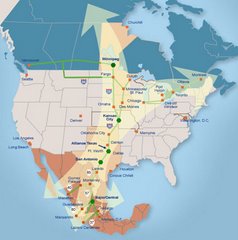
The TTC is a proposed corridor four-football fields wide running from Laredo up I-35 and eventually all the way to Canada. It is to have six lanes for traffic, four for trucks, two for automobiles. The corridor will also carry pipelines for natural gas, oil, water, electricity, and electronic data. The land will be taken by eminent domain. And you all know what eminent domain is. It is the loophole that lets politicians steal your land legally. This greedy serpent will ultimately be 4,000 miles long, each mile using 146 acres taken by eminent domain.

How does it sound so far? What about the cost to taxpayers? The state doesn't know.The governor implores us just to trust him.We'll all benefit, just trust him.

A super-super highway speeding goods and citizens across the country. On the surface, it sounds great, the sort of initiative someone courting the vice-presidency (U.S.) would come up with. But, what are the drawbacks?

There's a couple. Minor ones the governor suggests.

First, the initial contract was signed by the Spanish firm Cintra and its partner, Zachry Construction Corporation, with TxDOT for a 316-mile section of road to be built from San Antonio to Dallas. The contract includes what is known as a nocomplete clause. That means TxDOT has agreed not to improve any roadways that run parallel to the corridor for the duration of the 50 to 75 years of the Cintra lease, unless those improvements had already been approved prior to the signing of the contract.

That means when farm to market roads fall apart, citizens' only option is the TTC and pay the toll. Texans will be forced to use the TTC and pay tolls. Crossovers are from 24 miles apart. Farmers and ranchers whose property is cut in two must travel several miles to cross over.

Oh yes, I mentioned a toll to use the road, 44+ cents for cars and $1+ for trucks per mile in addition to the cost of gasoline; and the inconvenience of 40 miles between exits; and the fact the Cintra Zachary people will control all the gas stations, eating stops and whatever all along the route.

And then there is the little matter of about 700,000 acres ripped from farmers and ranchers by eminent domain.

Folks, this scheme makes the railroad robber barons of the old west look like street corner hustlers. Over my 70 years, I've seen many obscene efforts to make the rich richer, but this is the most outrageous I have ever witnessed.

This goes through, and then it is a matter of time before it reaches us.

Kent Conwell is retired from Port-Neches Groves ISD.

Another Senate Bill to block the TTC

Twenty-five of 30 Texas senators have co-authored the bill Tuesday evening that would require a two-year moratorium on public-private development agreements, which could put the Trans-Texas Corridor on hold.

SB1267
calls for setting up a group to study the long-term impacts of the state enlisting private corporations to build and operate toll roads in exchange for collecting profits.

SB1268 was also filed yesterday and would prevent any conversion of an existing free lane to a toll lane, regardless of whether or not local voters approved it.

Tuesday, March 6, 2007

Gov. Perry's Laundry List

News 8 Austin published an interesting article about the recent problems Perry and his staff are having. I'm going to summarize the article but here's a link.

"the Legislature is in near-open rebellion against the governor on toll roads and the Trans-Texas Corridor. Relations between the Texas Department of Transportation and key legislators have rarely been so bad."

Executive order mandating HPV vaccinations for 11-year-old girls:
Even his most reliable political base rebelled leaving the mandate in tatters.

Executive order to permit 11 coal plants: Turns out the utility really only needed three or four and intended to use the rest to trade for pollution credits. Then, TXU announced it was going to be bought in a deal that could possibly leave Texas largest electricity provider burdened with crippling debt.

Sexual abuse at
the Texas Youth Commission and possible 2 yr cover up: District Attorney Ronnie Earle has announced an investigation.

Last, in a few months a judge is expected to rule on a
class action lawsuit against the state, known as Frew v. Hawkins which argues that Medicare failed to provide basic services to children. Details at the Texas Medical Association. This case could cost the state billions of dollars that were not budgeted.


El Paso Mayor John Cook wants RMA and Toll Roads

"There is going to be three types of roads built in Texas, 'Toll roads, slow roads, and no roads.' So you pick which kind you want," said El Paso Mayor John Cook.


John Cook supports creating a Regional Mobility Authority (RMA) in El Paso to oversee road projects that cross state lines into Mexico and New Mexico.

"Under state law, the only vehicle that we have that can do projects in Mexico and New Mexico is a Regional Mobility Authority," said Cook.

Source: KFOX-TV

Sunday, March 4, 2007

183A now open - $1.80 for the 11.6 mile trip

Sunday morning is the first in which commuters can take advantage of a new toll road.

Highway 183A stretches north of 620 at 183 to Liberty Hill. The entire 11.6 miles will cost you $1.80.

Until May 1, everyone who uses this toll road will drive for free. TxTag drivers have until June 1 to drive without paying. Supporters say it will alleviate traffic on 183 from Cedar Park to Liberty Hill along with encouraging growth in the area.

Something to be aware of: the toll plaza near Lakeline Mall Drive will only accept electronic payments. That means you will have to have a TxTag, or you will get a violation notice in the mail.

Source: KXAN.com


Saturday, March 3, 2007

TxDOT 183A Mail Promo

This came in the mail today. Thanks for the info TxDOT.

HB998 to stop any toll road in TX until 2009

State Rep. Garnett Coleman, D-Houston, files HB998 to put a moratorium on any toll road in Texas that hasn’t been built. The bill is currently in the Transportation House Commitee.

80R4389 JTS-D

By: Coleman H.B. No. 998

A BILL TO BE ENTITLED

AN ACT

relating to a moratorium on tolls by the Texas Department of Transportation.

BE IT ENACTED BY THE LEGISLATURE OF THE STATE OF TEXAS:

SECTION 1. MORATORIUM ON TOLLS BY TEXAS DEPARTMENT OF TRANSPORTATION. The Texas Department of Transportation may not impose a toll for the use of any portion of a highway or roadway in the state highway system that did not have a toll in effect on or before the effective date of this Act.

SECTION 2. EXPIRATION. This Act expires September 1, 2009.

SECTION 3. EFFECTIVE DATE. This Act takes effect immediately if it receives a vote of two-thirds of all the members elected to each house, as provided by Section 39, Article III, Texas Constitution. If this Act does not receive the vote necessary for immediate effect, this Act takes effect September 1, 2007.

Perry spokesman - real classy guy

Yesterday thousands marched at the TX Capital in Austin in protest of the TTC and tolling current Freeways. Apparently Perry's office thinks little of public opinion and makes light of the fact that people are in opposition to the current plan.

"In the '40s, some protested against the farm-to-market road system, in the '50s some protested against the interstate highway system, and today some protesters will leave the rally against the TTC using those very same roads," Perry spokesman Robert Black said. "Ain't progress great!"

FULL STORY


Thursday, March 1, 2007

Carona’s take on toll road hearing

Austin Statesman

While the public hearing on toll roads droned on inside the Capital Extension auditorium around noon, the man responsible for today’s show took a few minutes to share what he sees as the big picture with reporters outside.

“The real focus has to be on public-private parterships” for toll roads, said state Sen. John Carona, R-Dallas, chairman of the Senate Transportation and Homeland Security Committee. “The Trans-Texas Corridor will take care of itself eventually. In fact, there’s a high probability they’re only one gubernatorial election from being abolished.”

The more insidious public policy issue, from Carona’s point of view, is the Texas Department of Transportation’s burgeoning use of so-called “comprehensive development agreements” where it contracts with private companies to build, operate and collect the profits from toll roads. That’s the approach being used on the proposed Trans-Texas Corridor, a network of cross-state toll roads promoted by Gov. Rick Perry.

But the department is also beginning to use such agreements for purely urban roads, agreeing this week with Spanish company Cintra for Cintra and its partners to take over the existing Texas 121 toll road north of Dallas and extend it. Under the company’s winning bid, it would pay the state $2.1 billion up-front and at least another $800 million over 50 years for the right to run the 26-mile road.

That bonanza, and others like it, will allow the state to build more highway projects faster. But it will also, Carona said, saddle drivers with the highest possible tolls for decades to come. Carona wants the Transportation Department to voluntarily pull back on such agreements, and he supports a bill he said that will soon be filed to put a moratorium on private road agreements with the state.

Beyond all that, Carona believes the Legislature was wrong to give the Transportation Department as much license as it has to build toll roads and use excess money from those roads for other transportation projects.

“Is a toll a toll, or is it to be allowed to be a tax?” Carona said. “Today’s tolls are just disguised taxes.”

Carona said he and his fellow legislators over his 19 years in the Legislature put the Transportation Department in a bad position by declining to raise the state gas tax, creating a transportation funding shortfall that now runs to the tens of billions.

“Everyone of us, myself included, are to blame,” Carona said. “But when you make a mistake, in politics just as in life, the best thing to do is correct it. It’s incumbent on us to change bad law.”

The bad law, in Carona’s view, are two massive transportation bills passed by the Legislature in 2003 and 2005. That 2003 bill, among many other things, authorized the Trans-Texas Corridor and expanded what could be done with public-private partnerships on roads.

Will any of this — raising the gas tax, limiting private road deals — happen this session? Carona is pessimistic, given that House Transportation Committee chairman Rep. Mike Krusee, R-Williamson County, and Perry are fully supportive of what the Transportation Department has been doing.

“I believe the majority of the House and a majority of the Senate, if given the chance, would vote to substantially curtail the power of the Department of Transportation,” Carona said. “The people of Texas, the people who hired us, want change. …Whether we can make these changes this session remains to be seen.”


TTC/Toll Hearing Reports - Austin, TX

03/01/07

NEWS:

KWTX-TV (Waco/Temple/Killeen)

Senators Grill Officials About Trans-Texas Corridor Project


Land Line Magazine

Texans call for repeal of proposed toll network


KCEN-TV (Killeen)


Proposed Trans Texas Corridor draws supporters and opponents to Austin


KXAN-TV (Austin)


Residents Swarm Capitol To Halt Texas Tollway


ABC13-TV (Houston)


Senators question transportation officials over toll road project


Star-Telegram


Hundreds demand toll road project's repeal


Houston Chronicle


Senators question transportation officials over toll road project


Wednesday, February 28, 2007

Tuesday, February 27, 2007

TTC - The next "Lexus Lanes"

A interesting article in the Waxahachie Daily Light compares the TTC to California's over-priced "Lexus Lanes".

The State Auditor Office released a report that concludes few will use the Trans-Texas Corridor due to high pricing. This and other studies say that by 2030, only about 24% of the traffic would be diverted from I-35 to the TTC on the congested areas between Dallas and San Antonio.

Corridor Watch spokesman David Stall is concerned about the TTC-35 projected tolls - and the impact on how that expense would affect people’s decisions to use the roadway.

“They’re going to make the tolls as much as people are willing to pay,” Stall said of any private entity that would take on any of the TransTexas Corridor’s planned 4,000 miles of toll roads.

“That’s exactly the opposite with what we have now (with state-run toll roads) that keep the toll as low as necessary,” he said, noting state-run toll roads’ motive is to keep traffic moving - not to make a profit.

“Private operators can raise the tolls as high as the market will bear,” Stall said, noting privately-run toll roads are familiar to people in California, where high tolls have led to the toll roads being nicknamed “Lexus lanes.”

Spanish company wins 121 toll contract in Dallas


Today State and regional officials announced an almost $3 billion deal for North Texas’ first privately operated toll road, State Highway 121 in Collin and Denton counties.

Cintra Concesiones de Infraestructuras de Transporte SA will pay $2.1 billion for the rights to operate the lucrative toll project through 2057. The Spanish company also has agreed to share an estimated $700 million in toll revenue in equal payments over the life of the contract.

State leaders tout the deal as the first of its kind in Texas, in which a single company will design, build and operate a substantial portion of the road. It also marks the first public-private deal in North Texas, and further solidifies Cintra’s presence in Texas’ growing toll road network. The company in late 2004 won the development contract for the Trans-Texas Corridor.

In winning the 121 contract, Madrid-based Cintra beat out two other heavy hitters in the toll road construction business: Skanska BOT of Sweden and Macquarie Infrastructure Group, which has roots in Australia.

The 121 deal must be ratified by the Texas Transportation Commission. Texas Department of Transportation officials will recommend Wednesday that the commission approve the deal, but the proposal still must clear financial and environmental reviews before it can be formally approved.


Source: TONY HARTZEL/Dallas Morning News


Friday, February 23, 2007

Georgia Law Markers Crack Down on Toll Violators

INNOCENT UNTIL PROVEN GUILTY? Not in Georgia or Texas-

This month the Georgia House voted to allow the state to collect unpaid tolls from the vehicles owner regardless of who was driving the car on the toll road.

Apparently, toll violators have racked up a bill of over $900,000 due to a loop-hole that prevented the state from collecting if they could not prove who was driving the car when the violation occurred. The change gives the state power to go after the Registered Owner of the vehicle regardless of who was driving the car.

The Registered Owner will also be fined $70 per violation, regardless of whether he or she was driving. The owner's registration would be revoked if they do not pay.

Source: www.georgiatolls.com, 02/22/06 - view source


Texas also fines the Registered Owner of a vehicle if they cannot prove who was driving. Read the CTRMA Toll Collection Policy here.

INTERNATIONAL toll-road operator banks on US market for Strong Earnings Growth


The Sydney Morning Herald reports today that Macquarie Infrastructure Group (MIG) is banking on US markets to continue strong earnings growth.

MIG chief executive Stephen Allen said he expected double-digit growth in earnings before interest, tax, depreciation and amortization in the next year, largely from US investments.

"[The US] continues to emerge as the most interesting market for private toll-road operators and in the medium term, remains a place we will be able to generate returns for our security holders," Mr. Allen said.

A major deal on the immediate horizon for MIG is the SH 121, a 22 kilometer toll road to be built near Dallas in Texas. MIG and Macquarie Infrastructure Partners will learn whether they are successful bidders by the end of the month.


About MIG-
(wikipedia)

Macquarie Infrastructure Group is one of the world's largest developers and operators of private toll roads with a portfolio of 11 toll roads across seven countries including Australia. The Macquarie Infrastructure Group is listed separately on the ASX, but is managed by a wholly owned subsidiary of Macquarie Bank Limited. Stephen Allen is the Chief Executive Officer of MIG.

MIG has a 100% stake in the M6 Toll road in the UK, which was constructed to relieve congestion on the M6 motorway—one of the UK's busiest motorways.

Additionally, as part of a consortium MIG has taken over operations of the Indiana East-West Toll Road and the Chicago Skyway, both part of Interstate 90 in the United States; and by itself has a 100% interest in the Dulles Greenway and the greenfield South Bay Expressway, scheduled to open in mid-2007, also in the United States. MIG also has a 47.5% interest in the Westlink M7 to the west of Sydney in Australia, a 30% interest in the 108km-long 407 ETR in Toronto, Canada, and a 20.4% interest in the Autoroutes Paris-Rhin-Rhone motorway network covering some 2205km of north-eastern France.

Thursday, February 22, 2007

Austin Chamber of Commerce Launches "Take On Traffic" and Supports Toll Roads

On 2/20/07, the Austin, TX Chamber of Commerce announced it's jumping into the hot topic of the day. In there press announcement (view announcement video), they claim to support a comprehensive transportation system which includes new roads, toll roads, express bus service and passenger rail.

On their website Takeontraffic.com, they blame population growth and lack of funding for the congestion. They state that in the Austin area, 500 new cars are added each week. As a cute way to illustrate the point, they have a counter of "New cars on the road in 2007" with a 20 minute clock counting backwards. At the end of each 20 minute cycle the counter increases.


Their message seems well balanced until they talk about FUNDING. On this subject, the Chamber seems to push Toll Roads while pointing out the negatives to all other funding options. It's disappointing to see this group so unfocused on fiscal responsibility with the current use of our tax dollars but so eager to push toll roads. They do mention that "clear policies and accountable leadership" are needed, but that does not appear to be the agenda they are pushing. I am eager to see proposals on fiscal responsibility but their "Accountability" page is currently empty and "Coming Soon".

Gas Tax -
CONS: add 30-50 cents/gal and could have a severe impact on lower-income residents and on the regional economy.

Sales Tax -
CONS: add 2 to 3 cents to current, Sales tax can be a volatile revenue source, going up and down dramatically depending on economic trends.

Property Tax (bonds) -
CONS: $200 a year for the next 20 years

Toll Roads -
CONS: NONE!
"The tolls collected on new roads like SH 130 pay back the bonds that financed initial construction. Once those bonds are paid off, tolls can be lowered to the level needed to simply pay for maintenance. [Not if they are run by private CORP for profit for 50-75 years!] Or they can be used to fund other needed projects — like sidewalks, bike lanes, or bus service — that help make up a comprehensive system.

Tolls have been controversial in Central Texas, especially for projects where new toll lanes would be built in existing highway corridors. (No project in Central Texas involves tolling existing highway lanes.) [FALSE - I used to be able to drive Mopac to I35 and North 183 to Cedar Park without a toll] Clear policies and accountable leadership are needed to make sure tolling is implemented wisely. However, compared to taxes, tolls have the advantage of only affecting the people who choose to drive on those roads, while still producing enough revenue to make a difference."

Senate committee approves two nominees to the Texas Transportation Commission

2/22/07

Ned Holmes of Houston and Fred Underwood of Lubbock where approved by the Senate Nominations Committee after a grilling.

The Texas Transportation Commission has five members, all appointed by Governor Perry.

According to statesman.com, the two at "
times looked like deer caught in headlights, as senators grilled them about their views on controversies that have been swirling for months around the agency's management and operations."


So what is the
Texas Transportation Commission?
Here's what TxDOT says:

The Texas Transportation Commission consists of five commissioners appointed by the Governor with the advice and consent of the senate to govern the Texas Department of Transportation (TxDOT). The commissioners' six-year terms are staggered, so that an appointment is generally made every two years. The governor designates one commissioner to serve as the chair.

What are the commission’s responsibilities?
  • planning and making policies for the location, construction and maintenance of state highways,
  • overseeing the design, construction, maintenance and operation of the state highway system,
  • developing a statewide transportation plan that contains all modes of transportation, including highways and turnpikes, aviation, mass transportation, railroads, high-speed railroads and water traffic,
  • awarding contracts for the improvement of the state highway system,
  • encouraging, fostering and assisting in the development of public and mass transportation in the state, and
  • adopting rules for the operation of the department.
A complete list of Commission duties is available in the Texas Administrative Code.

Who determines which projects to present to the commission?

A majority of the state's transportation program is determined locally. Most projects involving local roads or improvements to existing highways are selected by TxDOT's districts and divisions.

Major projects that improve mobility or safety are selected by the commission as part of the Unified Transportation Program, a 10-year statewide plan for transportation project development. These high-cost projects must compete with similar jobs from all over the state to receive funding.

Each must follow three authorization stages: planning, development and construction. Due to complex planning and development requirements, the commission selects projects up to four years in advance based on anticipated funding.


For a complete FAQ list, visit http://www.txdot.state.tx.us/frequently_asked_questions/commission.htm


Wednesday, February 21, 2007

back again

Sorry for the adsence, I've been having some account problems.

Monday, February 12, 2007

Bill to protect personal information of Toll Road users

2/12/07

In addition to HB719 and HB857 relating to toll roads, TX State Rep. Lebowitz has filed HB570 which will protect personal information that toll agencies gain from vehicle license plates of drivers who use toll roads.

The bill will restrict the use of information to only:
a) toll collection and toll enforcement
b) law enforcement purposes by request of a law enforcement agency

This bill also calls for the same controls if a toll entity enters into an agreement to share information with an entity in another state.

Full test of HB570 can be read on the TX Legislator webite.

All three House Bills are currently in review by the Transportation Committee.

Who chairs the Transportation Committee?
Mike Krusee, dubbed a "Double Taxer" by founders of TexasTollParty.com chairs the Transportation Committee. In 2001, he authored HB3588 which allowed creation of the Central Texas Regional Mobility Authority (CTRMA) and gave it power to construct, maintain and operate toll roads including raising revenue and acquiring property without public vote. The "Double Taxer" term refers to putting tolls on existing roads or roads already planned to build with public tax money.
With the passing of HB3588, the CTRMA was formed in 2002 with Mike Heilgenstien as executive director. CTRMA has come under fire by the Texas Comptroller who points to evidence that its board members have personal holding and business interests that present a conflict of interests. In 2005 she called for the resignation of it's chairman and a board member.

It will be interesting to see how Mike Krusee's role as Transportation Committee Chair will impact HB719 and HB857.

~AustinMojo~

Toll roads: Paying a lot to drive a little

$1.50-per-mile spot near Lakeline Mall illustrates fee discrepancies.


Read entire article from Austin American Statesman and commentary by Sal Costello.

Another section of 183A toll road opens


The Map above shows the entire project.

A new portion of the 183A toll road is now open to drivers.

It's a short northbound section between the Lakeline Blvd exit in northwest Austin and a new Avery Ranch Blvd exit (WORK AREA 2).

When finished, the toll road will run more than 11.5 miles starting around Lakeline Mall and extending through Cedar Park and Leander, stopping at the San Gabriel River.

The entire project is scheduled to be open on March 3.

But here's something interesting that you may not know about 183-A.

When you get off at Lakeline Mall Drive, your only option is to pay electronically.

There will be no cash booths available.

The Central Texas Regional Mobility Authority told KXAN that there will be signs posted letting drivers know that there will not be a cash option.

"By the number of people who are signing up for TxTags, it's pretty clear that most folks want to have a TxTag. It is the preferred way to pay," Steve Pustelnyk with the Central Texas Regional Mobility Authority said.

So what happens if you don't have a TxTag and only cash?

You'll go through, the lights will go off, and the camera will take a picture of your license plate and send you a bill.

When 183-A officially opens next month, you'll be able to drive on it for free through May 1.

News8Austin

KXAN


Friday, February 9, 2007

Credit Cards coming toToll Roads

Cards coming to vending machines, toll roads

Cadbury Schweppes Americas Beverages is working with MasterCard and USA Technologies Inc. to equip 1,000 vending machines with e-Port cashless transaction solutions to accept credit card payments. CSAB's machines (selling Dr Pepper, 7Up, Snapple and Canada Dry) in Dallas, New York and Chicago will be enabled to accept major credit cards, including MasterCard's PayPass.

Also, MasterCard, USA Technologies and Paywerks Inc. are conducting a PayPass trial at exit lanes and service plazas on the Ohio Turnpike, reportedly the first toll road in the country to accept payment cards for self-service toll transactions.

Sources: www.amonline.com and www.greensheet.com


Thursday, February 8, 2007

Public Hearing on Toll Roads, TTC set for 3/1/07, Austin, TX

February 8, 2007

NOTICE OF PUBLIC HEARING

TEXAS SENATE

Transportation & Homeland Security Committee

Senator John Carona, Chairman

8:30 AM – Thursday, March 1, 2007

Capitol Extension Auditorium

Public Hearing on State Policy For:

  • Toll Roads

  • Public Private Partnerships

  • Trans Texas Corridor


The Capitol Extension Auditorium is the largest meeting room in the Extension, seating approximately 350 people. It has a small stage and can be used for legislative functions requiring more space than a standard committee room.

The Capitol Extension, located on the north side of the Capitol, is a four-level underground structure which was completed in 1993. It was built to provide the Capitol with much-needed additional space without detracting from its appearance and historical importance. It is connected to the Capitol by three pedestrian tunnels.

For a map of the Capitol Extension CLICK HERE


Transportation & Homeland Security Committee

Senator John Carona, Chairman

Chair Vice-Chair Members:
Clerk: John W. Webb
Tel: (512) 463-0067
Sam Houston Building
Room 445


Rally at the Capitol planned the next day 3/2/07

What: Don’t Tag Texas Rally

Who/Why: Several organizations led by Hank Gilbert, Farm & Ranch Freedom, and others are sponsoring a rally to protest the Trans-Texas Corridor (TTC) and the National Animal Identification System (NAIS).

When: Friday, March 2, 2007 - Texas Independence Day

Time: The March will begin at 2:00 pm. The rally on the steps of the Capitol will be from 2:30 pm to 5:30 pm.

More info at www.dont-tagtexas.com


Volunteers are needed to visit legislative offices. CorridorWatch will
provide you with all necessary materials, instruction and directions.
If you can help us at the Capitol on Thursday, March 1st (and/or Friday,
March 2nd), please contact our Legislative Liaison Heidi Ullrich at
heidi@corridorwatch.org or by telephone at 512.585.3110.

Toll foes show up in force at hearing

2/7/07 - San Antonio, TX

Toll critics weren't allowed to set up a table to greet crowds coming into a public hearing Tuesday for a proposed U.S. 281 tollway, but once inside they made their point.

When Joe Krier, president of the Greater San Antonio Chamber of Commerce, got up to explain how tolls could fund twice as many miles of express lanes in half the time, letting motorists pay if they want to avoid worsening traffic congestion, boos laced the applause that followed.

When toll critic Terri Hall, leader of the San Antonio Toll Party, addressed the hearing to say that gas tax money can pay for what's needed on U.S. 281 and warned how foreign companies would suck million of dollars in profits from motorists, many in the crowd stood to cheer.

And there were a lot of people to make noise.

The Texas Department of Transportation, which held the hearing in the main ballroom of the Alzafar Shrine Temple to get input on its draft environmental assessment for the project, counted 652 people, far more than in attendance at most other local public hearings.

Almost one in 10 who showed signed up to speak.


More at MySanAntonio.com


Monday, February 5, 2007

All 3 Texas Parties Oppose Trans-Texas Corridor!!

So why are we still having this debate?

2006 TX Republican Party Platform
Page-10. "Tran-Texas Corridor - Because there are issues of confiscation of private land, state and national sovereignty and other similar concerns, we urge the repeal of the Trans-Texas Corridor legislation,”

Page-24. "Tolls on Existing Roads - We oppose tolls charged for traversing previously toll free roadways and disallow continued tolls except for maintenance on existing toll roads already paid for."


2006 Texas Democratic Party Platform
Page 21. "We oppose the proposed Trans-Texas Corridor, a proposal that is little more than an attempt to transfer ownership of a strip down the middle of the state to a foreign corporation with close ties to the Governor, which could have a potentially devastating effect on rural areas, property owners and communities."


2006 Texas Libertarian Party Platform
"3. TOLL ROADS Libertarians oppose the Trans Texas Corridor Act, a costly boondoggle intended to benefit land developers through the abuse of eminent domain and the power of highway monopoly. Further, we support legislation that would forbid tolls on any highway right of way which was obtained with tax dollars or through the use of eminent domain or condemnation."

Bills filed to stop TTC and conversion of existing roads to Tolls

San Antonio-area lawmaker State Rep. David Leibowitz has filed the following bills.

Links to the Bills on State website.
HB719 (1/23/07) and HB857 (1/25/07)

80R3227 JTS-D

By: Leibowitz H.B. No. 719

A BILL TO BE ENTITLED

AN ACT

relating to the operation of a state highway or segment of a state highway as a toll project.

BE IT ENACTED BY THE LEGISLATURE OF THE STATE OF TEXAS:

SECTION 1. Section 228.201, Transportation Code, is amended to read as follows:

Sec. 228.201. LIMITATION ON TOLL PROJECT [FACILITY] DESIGNATION. The [(a) Except as provided by Section 228.2015, the] department may not operate a [nontolled] state highway or a segment of a [nontolled] state highway as a toll project, and may not transfer a highway or segment to another entity for operation as a toll project, unless:

(1) [the commission by order designated the highway or segment as a toll project before the contract to construct the highway or segment was awarded;

[(2)] the highway or segment was open to traffic as a turnpike project on or before September 1, 2005;

(2) [(3)] the project was designated as a toll project when the project was initially described in a plan or program for roads released or disclosed to the public by:

(A) [of] a metropolitan planning organization, if the proposed toll project is located in the territory of a metropolitan planning organization; or

(B) the department, if the proposed toll project is not located in the territory of a metropolitan planning organization [on or before September 1, 2005;

[(4) the highway or segment is reconstructed so that the number of nontolled lanes on the highway or segment is greater than or equal to the number in existence before the reconstruction;

[(5) a facility is constructed adjacent to the highway or segment so that the number of nontolled lanes on the converted highway or segment and the adjacent facility together is greater than or equal to the number in existence on the converted highway or segment before the conversion;

[(6) subject to Subsection (b), the highway or segment was open to traffic as a high-occupancy vehicle lane on May 1, 2005]; or

(3) [(7)] the commission converts the highway or segment to a toll project [facility] by:

(A) making the determination required by Section 228.202;

(B) conducting the hearing required by Section 228.203; and

(C) obtaining county and voter approval as required by Sections 228.207 and 228.208.

[(b) The department may operate or transfer a high-occupancy vehicle lane under Subsection (a)(6) as a tolled lane only if the department or other entity operating the lane allows vehicles occupied by a specified number of passengers to use the lane without paying a toll.]

SECTION 2. This Act takes effect immediately if it receives a vote of two-thirds of all the members elected to each house, as provided by Section 39, Article III, Texas Constitution. If this Act does not receive the vote necessary for immediate effect, this Act takes effect September 1, 2007.


80R3969 DWS-D

By: Leibowitz H.B. No. 857

A BILL TO BE ENTITLED

AN ACT

relating to repeal of authority for the establishment and operation of the Trans-Texas Corridor.

BE IT ENACTED BY THE LEGISLATURE OF THE STATE OF TEXAS:

SECTION 1. Section 11.11(j), Tax Code, is amended to read as follows:

(j) For purposes of this section, any portion of a facility owned by the Texas Department of Transportation that is [part of the Trans-Texas Corridor, is] a rail facility or system[,] or is a highway in the state highway system, and that is licensed or leased to a private entity by that department under Chapter 91 or[,] 223, [or 227,] Transportation Code, is public property used for a public purpose if the rail facility or system, highway, or facility is operated by the private entity to provide transportation or utility services. Any part of a facility, rail facility or system, or state highway that is licensed or leased to a private entity for a commercial purpose is not exempt from taxation.

SECTION 2. Section 25.06(c), Tax Code, is amended to read as follows:

(c) This section does not apply to:

(1) any portion of a facility owned by the Texas Department of Transportation that is [part of the Trans-Texas Corridor, is] a rail facility or system[,] or is a highway in the state highway system and that is licensed or leased to a private entity by that department under Chapter 91[, 227,] or 361, Transportation Code; or

(2) a leasehold or other possessory interest granted by the Texas Department of Transportation in a facility owned by that department that is [part of the Trans-Texas Corridor, is] a rail facility or system[,] or is a highway in the state highway system.

SECTION 3. Section 25.07(c), Tax Code, is amended to read as follows:

(c) Subsection (a) does not apply to:

(1) any portion of a facility owned by the Texas Department of Transportation that is [part of the Trans-Texas Corridor, is] a rail facility or system[,] or is a highway in the state highway system and that is licensed or leased to a private entity by that department under Chapter 91[, 227,] or 361, Transportation Code; or

(2) a leasehold or other possessory interest granted by the Texas Department of Transportation in a facility owned by that department that is [part of the Trans-Texas Corridor, is] a rail facility or system[,] or is a highway in the state highway system.

SECTION 4. Sections 201.616(a) and (b), Transportation Code, are amended to read as follows:

(a) Not later than December 1 of each year, the department shall submit a report to the legislature that details:

(1) the expenditures made by the department in the preceding state fiscal year in connection with:

(A) the unified transportation program of the department;

(B) turnpike projects and toll roads of the department; and

(C) [the Trans-Texas Corridor;

[(D)] rail facilities described in Chapter 91; [and

[(E) non-highway facilities on the Trans-Texas Corridor if those expenditures are subject to Section 227.062(c);]

(2) the amount of bonds or other public securities issued for transportation projects; and

(3) the direction of money by the department to a regional mobility authority in this state.

(b) The report must break down information under Subsection (a)(1)(A) by program category and department district. The report must break down information under Subsections (a)(1)(B) and[,] (C)[, (D), and (E)] and Subsection (a)(3) by department district. The report must break down information under Subsection (a)(2) by department district and type of project.

SECTION 5. Section 202.112(a), Transportation Code, is amended to read as follows:

(a) The commission may purchase an option to acquire property for possible use in or in connection with a transportation facility[, including a facility as defined by Section 227.001,] before a final decision has been made as to whether the transportation facility will be located on that property.

SECTION 6. Section 222.003(e), Transportation Code, is amended to read as follows:

(e) The proceeds of bonds and other public securities issued under this section may not be used for any purpose other than any costs related to the bonds and other public securities and the purposes for which revenues are dedicated under Section 7-a, Article VIII, Texas Constitution. [The proceeds of bonds and other public securities issued under this section may not be used for the construction of a state highway or other facility on the Trans-Texas Corridor. For purposes of this section, the "Trans-Texas Corridor" means the statewide system of multimodal facilities under the jurisdiction of the department that is designated by the commission, notwithstanding the name given to that corridor.]

SECTION 7. Section 223.201(a), Transportation Code, is amended to read as follows:

(a) Subject to Section 223.202, the department may enter into a comprehensive development agreement with a private entity to design, develop, finance, construct, maintain, repair, operate, extend, or expand a:

(1) toll project;

(2) [facility or a combination of facilities on the Trans-Texas Corridor;

[(3)] state highway improvement project that includes both tolled and nontolled lanes and may include nontolled appurtenant facilities;

(3) [(4)] state highway improvement project in which the private entity has an interest in the project; or

(4) [(5)] state highway improvement project financed wholly or partly with the proceeds of private activity bonds, as defined by Section 141(a), Internal Revenue Code of 1986.

SECTION 8. The following provisions of the Transportation Code are repealed:

(1) Section 201.618(e);

(2) Chapter 227;

(3) Section 370.316; and

(4) Section 545.3531.

SECTION 9. This Act takes effect immediately if it receives a vote of two-thirds of all the members elected to each house, as provided by Section 39, Article III, Texas Constitution. If this Act does not receive the vote necessary for immediate effect, this Act takes effect September 1, 2007.


TX Motor Fuel Tax Proposal

2/5/07 - Motor fuel tax

......... One of the more far-reaching proposals would revamp the state gasoline tax so that it automatically increases to reflect inflation.

Sen. John Carona, the Dallas Republican who chairs the Senate Transportation and Homeland Security Committee, said he filed the legislation to give Texas an alternative to toll roads.

Under his proposal, the motor fuel tax would be slightly increased each year to reflect the effects of inflation on highway construction costs. The current tax is 38 cents per gallon – 20 cents for the state and 18 cents for the federal government.

Mr. Carona said the annual tax increase probably would run about a penny or so per gallon, which would cost a typical driver who uses a thousand gallons of gasoline a year an extra $1 per month.

"If we do that over the next 25 years, we'll be able to leverage those additional funds into [highway] bond issues in excess of $45 billion" which he said would cover most estimated transportation needs over that period.

But if the tax is left alone, he said, toll roads will be the state's main option, and it could cost drivers $2 per day.

"The math is pretty obvious," the senator said. "It's not just a little more expensive for Texas drivers, it's a lot more expensive to build toll roads."

Gov. Rick Perry, who envisions a broad network of privately run toll roads across Texas, says that's the best way to meet the state's rapidly growing transportation needs.

Source: KVUE